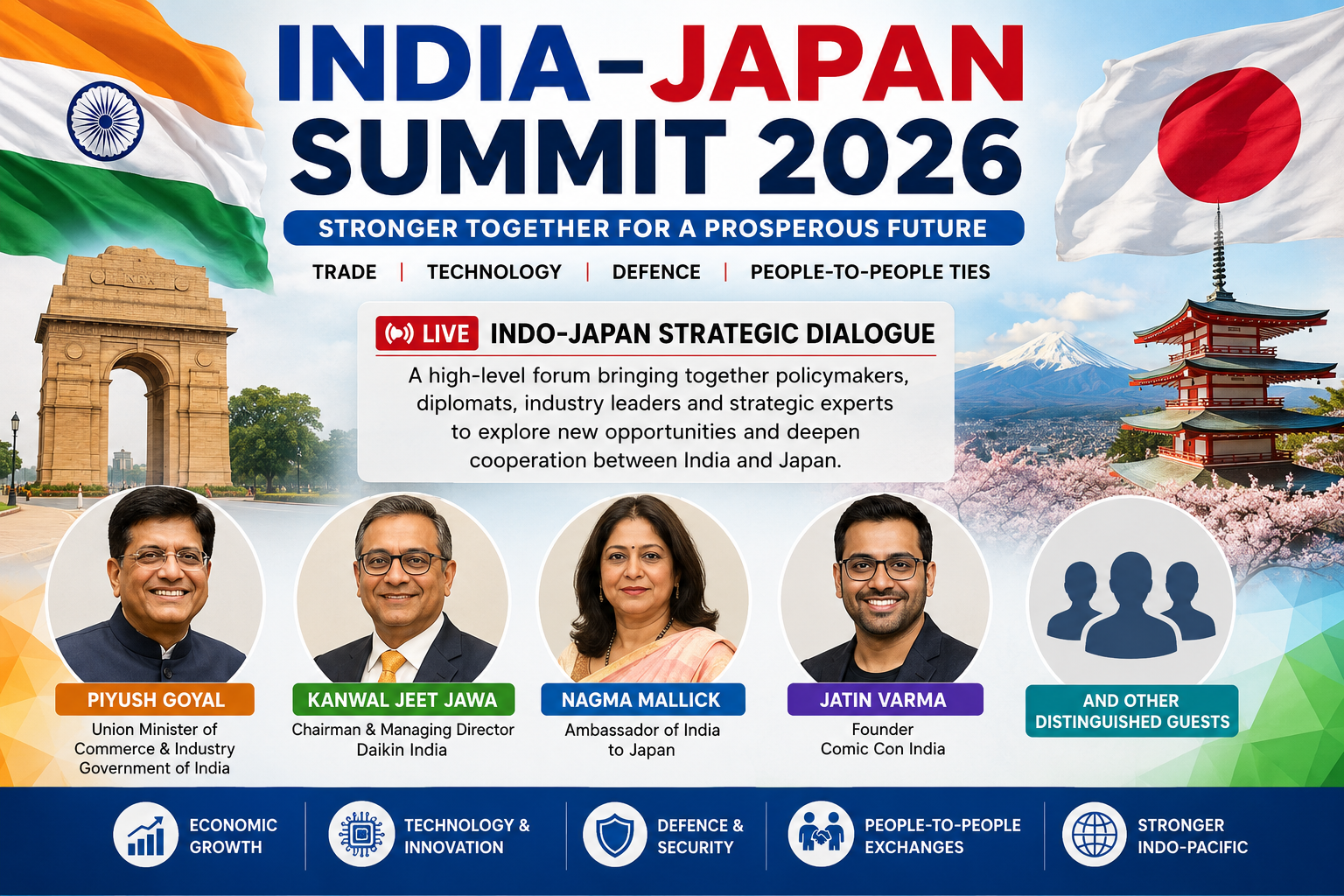
As India and Japan continue to strengthen one of Asia's most significant strategic partnerships, policymakers, diplomats, business leaders, and experts convened in New Delhi on Thursday for the Indo-Japan Strategic Dialogue 2026, a high-profile forum aimed at expanding cooperation in trade, technology, defence, innovation, infrastructure, and cultural exchanges.
Hosted by NDTV, the summit comes at a time when the two Indo-Pacific democracies are seeking to deepen collaboration amid evolving geopolitical dynamics, supply chain realignments, and rapid technological transformation. The event serves as a platform for discussing new opportunities while reaffirming the shared commitment of both nations to a free, open, and rules-based Indo-Pacific.
The dialogue featured an impressive lineup of speakers representing government, diplomacy, industry, and the creative sector, reflecting the broad scope of India-Japan relations that now extend well beyond traditional economic cooperation.
Strengthening a Comprehensive Strategic Partnership
Over the past decade, India and Japan have significantly expanded bilateral engagement across multiple sectors. From high-speed rail projects and infrastructure development to semiconductor manufacturing, clean energy, defence cooperation, and digital innovation, the partnership has become one of the pillars of regional stability and economic growth.
Addressing the gathering, Union Commerce and Industry Minister Piyush Goyal emphasized the growing economic synergy between the two nations. He highlighted India's emergence as one of the world's fastest-growing major economies and invited greater Japanese investment in manufacturing, electronics, green technologies, and advanced industries.
The minister reiterated that initiatives such as Make in India, Digital India, and the Production Linked Incentive (PLI) schemes continue to create new opportunities for Japanese companies looking to diversify global supply chains.
Experts noted that Japanese businesses increasingly view India as a preferred investment destination due to its expanding domestic market, improving infrastructure, policy reforms, and skilled workforce.
Business Leaders Focus on Innovation and Manufacturing
Industry leaders participating in the dialogue stressed the importance of expanding industrial cooperation beyond traditional sectors.
Daikin India Chairman and Managing Director Kanwal Jeet Jawa discussed the company's long-term commitment to India's manufacturing ecosystem and highlighted the growing role of sustainable technologies, energy-efficient solutions, and local production.
Business representatives also pointed to opportunities in artificial intelligence, robotics, electric mobility, renewable energy, healthcare technology, and semiconductor manufacturing—areas expected to define the next phase of bilateral collaboration.
Participants agreed that closer industry partnerships would not only benefit both economies but also strengthen resilient global supply chains in an increasingly uncertain international environment.
Diplomatic Engagement Remains Strong
India's Ambassador to Japan Nagma Mallick underlined the importance of sustained diplomatic engagement in strengthening mutual trust and expanding cooperation across diverse sectors.
She highlighted the remarkable growth in people-to-people exchanges, educational partnerships, tourism, cultural collaborations, and academic cooperation, noting that stronger societal connections are becoming an essential pillar of the bilateral relationship.
The ambassador also emphasized that India and Japan continue to work closely on regional and global issues through forums such as the Quad, while maintaining a shared commitment to peace, economic development, and maritime security.
Defence and Indo-Pacific Security in Focus
Security cooperation remained a major theme throughout the discussions.
As strategic partners in the Indo-Pacific, India and Japan have steadily expanded defence ties through joint military exercises, maritime cooperation, intelligence sharing, and defence technology collaboration.
Experts observed that growing geopolitical challenges have reinforced the importance of closer coordination between the two countries in ensuring regional stability, safeguarding sea lanes of communication, and promoting international law.
Participants stressed that defence cooperation is expected to become even more comprehensive in the coming years, particularly in emerging domains such as cyber security, space technology, and advanced defence manufacturing.
Culture, Creativity and Youth Engagement
The summit also highlighted the expanding cultural relationship between India and Japan.
Comic Con India founder Jatin Varma spoke about the growing popularity of Japanese anime, manga, gaming, and pop culture among Indian youth. The discussion reflected how cultural exchanges have become a powerful bridge connecting younger generations of both countries.
Experts noted that student exchanges, language education, tourism, entertainment, and collaborative creative industries are increasingly contributing to stronger bilateral ties beyond government and business engagement.
Looking Ahead
As global economic and strategic priorities continue to evolve, analysts believe India and Japan are well-positioned to emerge as trusted long-term partners across multiple sectors.
From infrastructure development and advanced manufacturing to clean energy, digital technologies, healthcare, and innovation, the scope for collaboration continues to expand.
The Indo-Japan Strategic Dialogue 2026 reinforced the shared vision of both nations to build a resilient, technology-driven, and sustainable partnership capable of addressing future global challenges. With governments, businesses, and civil society working in tandem, the India-Japan relationship is expected to play an increasingly influential role in shaping the economic and strategic landscape of the Indo-Pacific region.
The discussions concluded with a strong message of optimism, reaffirming that the enduring friendship between India and Japan is entering a new phase marked by deeper cooperation, mutual trust, and a shared commitment to inclusive growth and regional stability.