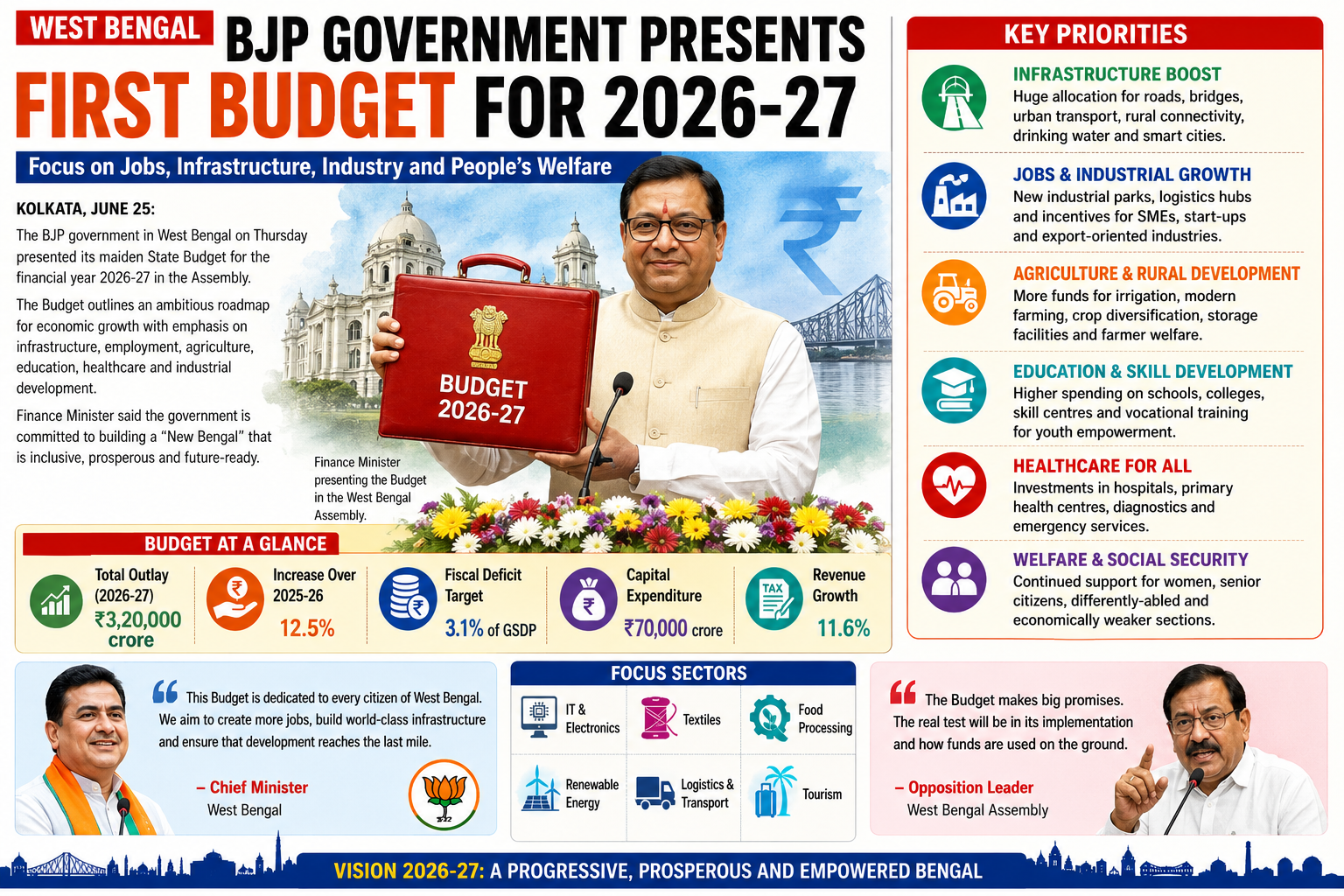
The Bharatiya Janata Party (BJP) government in West Bengal on Thursday presented its maiden State Budget for the financial year 2026-27, outlining an ambitious roadmap aimed at accelerating economic growth, boosting employment, strengthening infrastructure, and improving public services across the State.
The Budget, the first since the BJP assumed office in the State, seeks to balance fiscal discipline with increased spending on development projects, welfare initiatives, agriculture, education, healthcare, and industrial expansion.
Presenting the Budget in the State Assembly, Finance Minister stated that the government is committed to transforming West Bengal into a leading investment destination while ensuring that the benefits of development reach every section of society.
Major Focus on Infrastructure Development
A significant portion of the Budget has been allocated for infrastructure projects, including the construction and modernization of roads, bridges, urban transport systems, and rural connectivity networks. The government announced plans to upgrade several highways and improve transportation links between industrial hubs and major ports.
Special emphasis has also been placed on strengthening civic infrastructure in Kolkata and other urban centres, with investments proposed for drainage systems, drinking water projects, waste management facilities, and smart-city initiatives.
Employment and Industrial Growth
The government unveiled a series of measures aimed at generating employment opportunities for youth and attracting fresh investments into the State.
New industrial parks, logistics hubs, and manufacturing clusters are proposed under the Budget, along with incentives for small and medium enterprises (SMEs), start-ups, and export-oriented industries. The government expects these initiatives to create thousands of direct and indirect jobs over the coming years.
Officials said special packages would be introduced to encourage investment in sectors such as information technology, electronics, textiles, food processing, renewable energy, and logistics.
Agriculture and Rural Development
Agriculture remains a key priority in the Budget, with enhanced allocations for irrigation projects, crop diversification, modern farming techniques, and farmer welfare schemes.
The government also announced plans to strengthen rural infrastructure through investments in village roads, storage facilities, cold chains, and agricultural marketing networks. Financial assistance for farmers affected by natural disasters is expected to continue under revised support mechanisms.
Education and Skill Development
Recognising the importance of human capital development, the Budget proposes increased spending on schools, colleges, technical institutions, and vocational training centres.
Several skill development programmes are expected to be launched to prepare young people for emerging industries and modern employment opportunities. The government said partnerships with private industry would be encouraged to ensure that training programmes match market requirements.
Healthcare Gets Major Push
The healthcare sector has received a substantial allocation, with funds earmarked for the construction and modernization of hospitals, primary health centres, diagnostic facilities, and emergency medical services.
The government also announced plans to recruit additional healthcare professionals and expand access to affordable medical treatment in rural and underserved areas.
Welfare Measures Continue
While emphasizing development and investment, the Budget also retains a strong welfare component. Provisions have been made for social security programmes benefiting women, senior citizens, differently-abled persons, and economically weaker sections.
Officials said the government aims to ensure that economic growth remains inclusive and benefits all sections of society.
Fiscal Management and Revenue Mobilisation
The Budget outlines measures to improve tax collection efficiency, expand the revenue base, and attract private investment without imposing a significant burden on taxpayers.
The government expressed confidence that increased economic activity, industrial expansion, and infrastructure development would strengthen State finances over the medium term.
Political Significance
The presentation of the BJP government's first Budget is being viewed as a crucial policy statement that reflects the administration's governance priorities and long-term vision for West Bengal.
While the ruling party described the Budget as growth-oriented and development-focused, opposition parties demanded greater clarity on implementation timelines and funding mechanisms for several major projects.
As debates continue in the Assembly, the Budget is expected to shape the economic and political discourse in West Bengal over the coming year, with its success likely to be measured by its ability to deliver jobs, investment, infrastructure and improved public services across the State.